The room is gone. The train is hours away. The suitcase is yours until then.
That is the problem, and most storage pages do not answer it. They hand you the menu — coin lockers, luggage counters, storage apps, hotel front desks — describe each one fairly, rank none of them, and finish. Useful if you are planning at home. Useless in a concourse, holding the bag, with a decision to make in the next minute and a train that will not wait for the research.
Carrying it anyway is an option and a bad one. It makes stairs a decision. It takes up a person’s worth of room on a train. It parks you in doorways and on landings, which is precisely where a bag is most in the way.
So this is an order rather than a menu. Start at the top, stop when something works, and keep going down when it does not — including the step for when the lockers are full, which is the moment most of these pages quietly end.
The order to try, before you walk anywhere
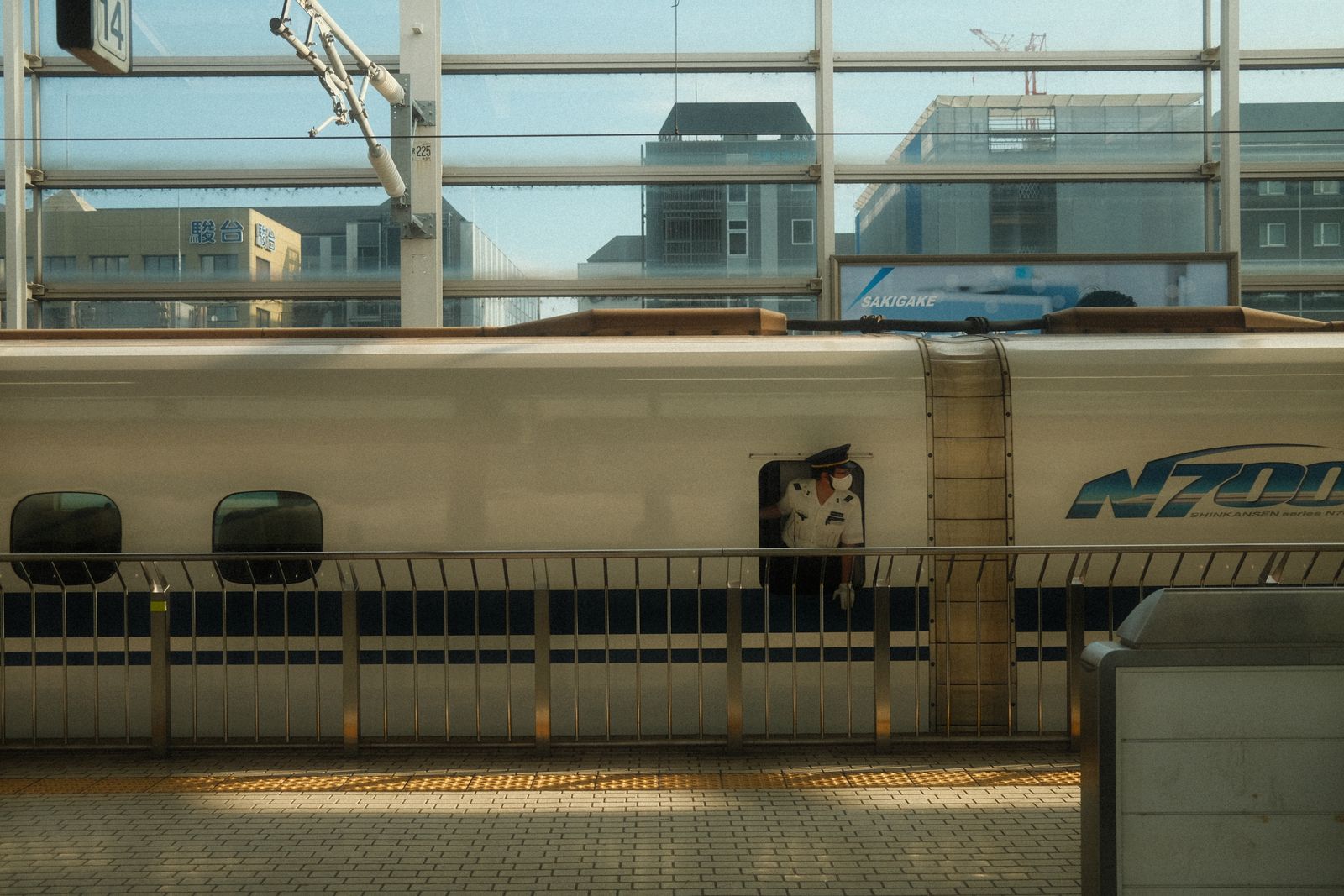
- If a shinkansen is in today’s plan, measure the bag before anything else. Add the three sides together. There is a size above which you are supposed to reserve space for it, and that is a decision for this morning, not for the gate.
- Ask the building you slept in, or the one you are checking into. It costs one question, and it is the only move here that needs no app, no coins and no walking.
- Book the store layer on your phone before you go looking. The booking comes first and the bag arrives second, so doing it while you still have two free hands is worth more than it sounds.
- Then the coin locker. Fastest thing on this list when it works, and the one most likely to have nothing left in the size you actually need.
- If it is full, or the bag fits nothing, do not start wandering. There is an order for that too, further down this page.
Where you enter depends on your moment: before check-in or after checkout, start at step 2; on a day trip back to the same building tonight, also step 2; standing at a shinkansen gate, step 1; no train today, skip step 1 entirely.
First, the bag itself: the rule that decides this before you leave
No shinkansen today? Skip to the next section — none of this applies to you. (Still deciding how to buy the tickets at all? That is a different question.)
What the rule actually is
Add the three sides of the bag together. That total is the whole rule.
- 160cm or less — overhead rack. No reservation, no fee.
- Above 160cm, up to 250cm — 特大荷物, oversized baggage. Reserve a seat that comes with space for it, or pay ¥1,000, tax included, for bringing it aboard unreserved.
- Above 250cm — it does not board. Not with a reservation, not for a fee. That ceiling is a separate rule, and an older one.
It covers the Tokaido, Sanyo, Kyushu and Nishi-Kyushu Shinkansen, per JR Central’s and JR West’s own pages, and it has been in force since 20 May 2020. It is not a new rule. Nor is every train fitted the same way — JR Central ties the reserved spaces to its sixteen-car formations.
One thing did change, and it is the thing most likely to mislead you. Since 1 July 2025, on a trial basis, the oversized-baggage space on some decks can be used without booking it ahead. That added an option. It did not remove the requirement, and the ¥1,000 is still on both operators’ pages.
The boundary the English pages get wrong
The operators’ Japanese says 「160cm超」 — strictly above 160cm. A bag whose three sides total exactly 160.0cm is outside the rule and needs no reservation. Four operator pages across two companies say 超. None of them says 以上.
The English does not survive the trip. One official English page renders it as “160cm or more,” which is wrong at the boundary. JR West’s says “between 160 and 250,” which is ambiguous — and then, further down the same page, “more than 160 cm,” which is correct. The operator’s own English contradicts itself.
Which leaves you holding this: the rule is above 160, and your 160.0cm bag is a bag that two English pages describe as needing a reservation.
JBJ'S TAKE
If you had to measure twice, reserve.
If the three sides add up to 158 or more, reserve. Above 160 that is not a judgment call. Between 158 and 160 the rule is on your side, and JbJ still says book it. Comfortably under, carry it and stop thinking about it.
Your number is softer than it looks. Wheels, handle, the pocket you stuffed this morning — if you had to decide what counted, that is an estimate, not a measurement. And the official English says "160cm or more," which is not a sentence you want to be arguing with.
Reserve in advance and whatever it costs, you chose it sitting down. Get it wrong and it is ¥1,000, tax included, on board, with the bag in your hands. At 159 that is not a close call.
The free move most guides bury
Ask.
Ask the place you slept in last night. Ask the place you are checking into tonight. Ask before you look at anything else on this page, because it is one sentence at a desk you are walking past anyway, and the worst outcome is that somebody says no and you have lost nothing.
Three moments where it is the right first question. Before check-in, when the room is not ready and the day has already started. After checkout, when you are out of the room in the morning and on a train in the evening. And on a day trip, when you are coming back to the same building tonight regardless.
Then the catch, and it is a real one. The bag stays where the building is. Leave it at the hotel you checked out of this morning and your day now has to end back at that hotel — fine if you were going that way, expensive in time if you were not. Nothing else on this page ties your route to one specific address like that.
So ask first, then decide. Not: ask, then assume it is settled.
JBJ'S TAKE
Ask first. Then plan the day around the answer.
Every other option here takes money and hands your day back. This one may take no money and takes a piece of the day instead, because the bag stays where the building is — and so, eventually, do you.
That is the trade-off, and it is why this is the first thing to try rather than automatically the right answer. Free storage is a leash. If the afternoon ends near where it started, take the leash. If you are checking out and heading for a station on the other side of town, pay for something that sits where you are going.
Ask anyway, even when you expect a no. It is one sentence at a desk you are walking past. Nothing else on this page is that cheap to find out.
Decide it before you walk
The move almost nobody makes is the useful one: book the storage before you are standing anywhere, the way you would book a table.
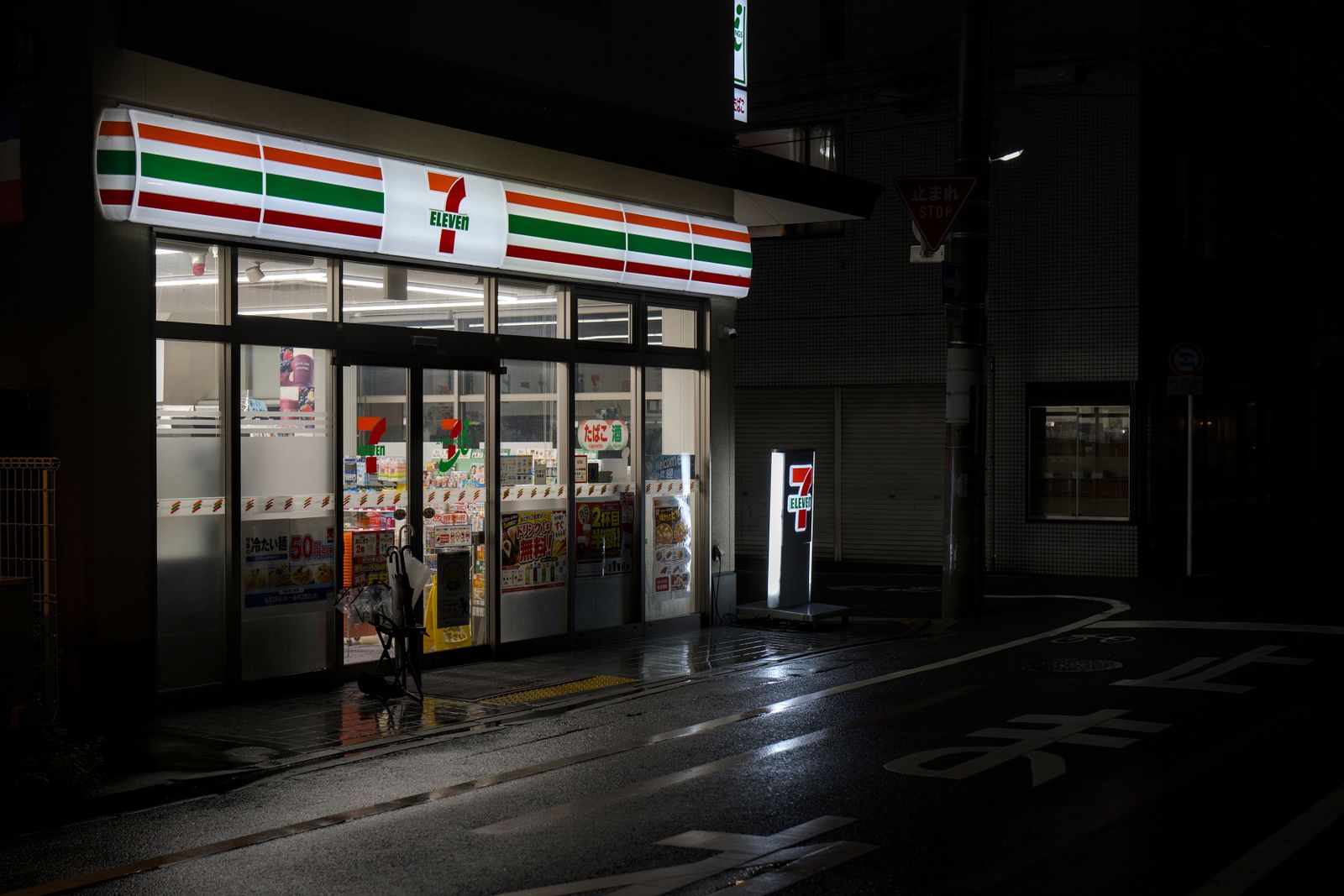
7-Eleven stores in Japan hold bags. The service is ecbo cloak, run with Seven-Eleven Japan out of store back-room space, and the count was 1,261 stores across 42 prefectures as of 15 July 2026 — up from 378 stores in December 2025, which tells you how fast this is moving. You book and pay in the app or on the website first, then take the bag to the store.
It is ¥500 a day for a bag whose largest dimension is under 45cm, and ¥800 a day at 45cm or over, tax included — with the operator’s own note that some locations charge differently.
The reason to do this first rather than last is what it accepts: suitcases, strollers, instruments, sports equipment, folding bicycles. Those are the things that do not go in a locker. So this is not a backup for the locker plan. For exactly the bag that made you read a page like this, it is a better plan than the locker plan.
The coin locker: what it is good for, and where it stops
Fastest option on the page, shortest instructions, no booking. It is also the one that can simply refuse you, which is why it sits at step 4 and not at step 1.
Sizes, and why nobody can give you one price
This is where most guides hand you a neat national price table. Every one of those tables is wrong, and it is worth thirty seconds to understand why, because it will save you a bad assumption at the machine.
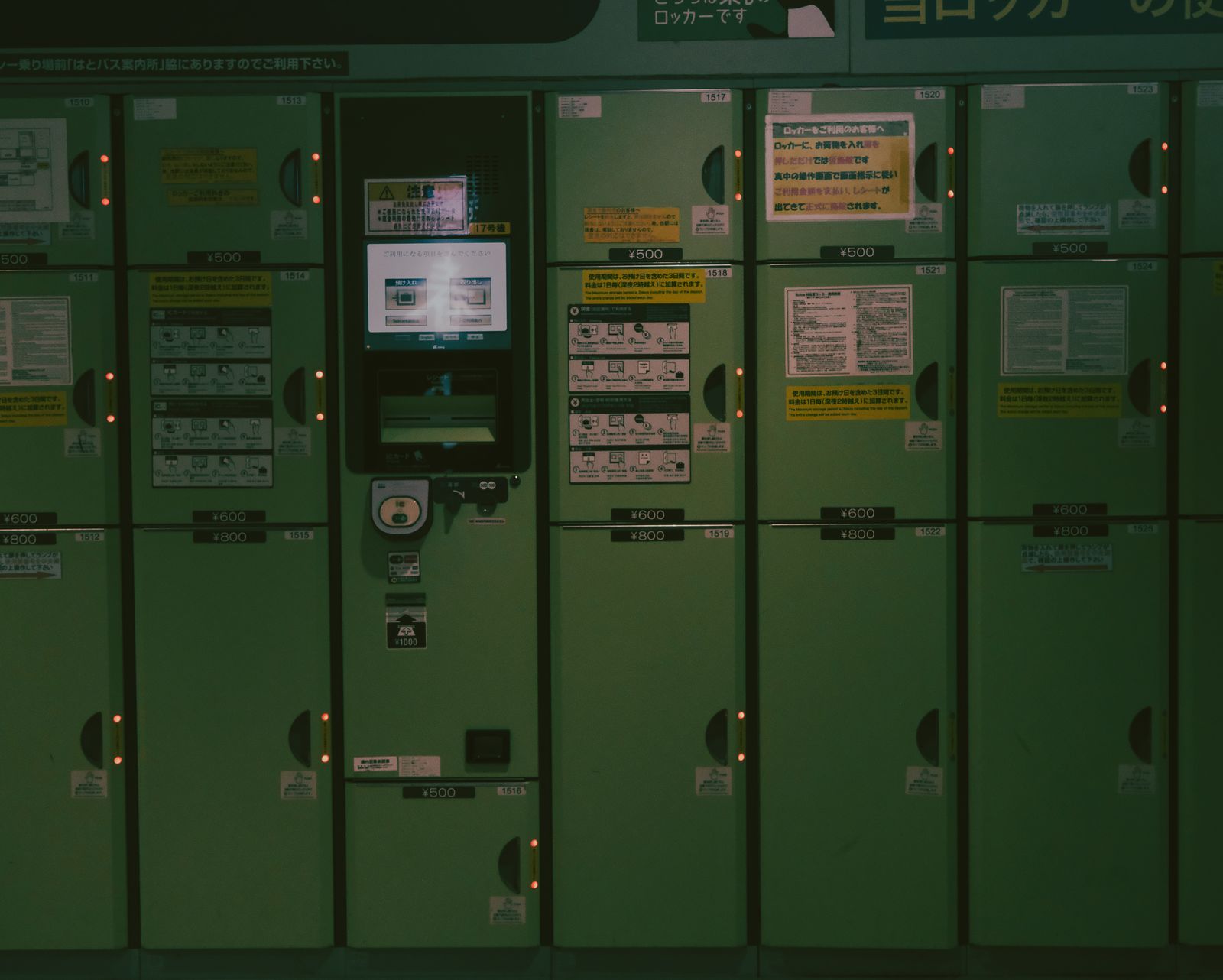
Prices are set per operator and per station. Kintetsu publishes its own range, dated 12 August 2026: ¥400–600 at the smallest size, up to ¥800–1,500 at the largest. That is one operator, and it is still a range inside that single network.
The size labels do not travel either. One operator’s 中 is not another operator’s 中 — different boxes, same character on the door.
You will also see ¥300 to ¥600 quoted as the national answer, including by the national tourism body. That is fair for small and medium boxes and it stops short of the large ones, which are the size you are actually here about. Budget ¥800–1,500 for a suitcase-sized locker. That is Kintetsu’s own published range for its largest size, and it is the right shape to plan around.
Operating one, briefly
There is not much to walk you through, and pages that walk you through it are padding. Pick a free door, put the bag in, pay, and keep whatever the unit gives you to get it back out.
One habit worth having: read the door before you commit the bag. The price and the terms are printed right there, and they are the ones that actually apply to you — not the ones in any guide, including this one.
When the big ones are full
This is the moment the rest of the page exists for, and the shortage is real enough that Japan’s own tourism agency has said so.
The Japan Tourism Agency’s visitor-complaint findings name 「コインロッカーの少なさ」 — not enough coin lockers — as a grievance visitors actually report, and the Agency has no storage to sell you. Seven-Eleven Japan does. When it opened its store back rooms to bag storage, the reason it gave in its own release was that lockers are insufficient — which is also the commercial case for a service it charges by the day, so read that line as a company describing the problem it profits from solving. Then read what it did rather than what it said. A convenience-store chain does not turn a thousand stock rooms over to strangers’ suitcases, and keep opening more, to solve a shortage it invented. Saying it is free. Building it was not. That is not proof your locker will be full. It is more than enough reason to have the next step ready before you are standing there.
Here is the order. Each step has a condition attached, and a condition for moving on.
- Go to the thing you booked. If you took step 3 this morning, this is already over. If you did not, you can still use it — but the booking is made in the app before the bag arrives at the store, so it is slower now than it would have been an hour ago.
- Go back to a building that knows your name. The hotel you left this morning, or the one you check into tonight. Worth the walk if either is within reach of where you are standing. Not worth it if you are already at the station you are leaving from.
- Ask at an information window whether the station has a staffed left-luggage counter. Where one exists it will take things a locker will not — oversized cases, odd shapes, sports gear. Ask the hours and the price in the same breath; both vary by station.
- Walk away from the busiest point. The bank by the main exit is the one everyone tries first, and it is the one that is always full. A different exit, a different level, or one station back down the line is usually enough. The first bank you found is almost never the only one.
- If the bag fits nothing at all, stop looking for a box. Go back up to steps 1 and 3 — the store layer takes suitcases, instruments and sports equipment, and a staffed counter, where the station has one, takes the shapes a locker will not. The bottom of this page is a different case: the bag that never has to come back to you.
Getting it back: the clock you didn’t notice starting
Two things about the clock are worth more to you than any price on this page.
The first is how days are counted. Where a limit is stated in days, the day you put the bag in is day one — JR Hokkaido says so explicitly, three days including the day you started, with its own note that stations differ. A bag left on Friday evening is therefore out of time on Sunday, not Monday.
The second is that three days is not a national rule. Nishitetsu says three. Narita Airport allows up to eight, and five on its extra-large units. One operator also spells out what happens past the limit, which is worth knowing about: Nishitetsu removes the bag and stores it at a daily fee equal to the locker’s rate, and disposes of it after thirty days.
Then there is billing. Narita states that the period from when you start using the locker until midnight counts as one day, with an excess charge after that — which makes nine in the evening to one in the morning four hours and two days’ money. It is not a universal rule, and Narita itself runs a second, time-based model on some of its own units. Do not assume you have bought a full twenty-four hours until you have read the unit.
When storage is the wrong answer
There is one case where none of this applies: when the bag does not need to come back to you at all. If you are changing cities and the suitcase should simply be waiting at the next hotel, the question is forwarding rather than storage, and it runs on different counters and different rules.
That one is handled in the convenience store guide, where the counters that send it are.
JBJ'S TAKE
The order is the answer.
Measure the bag if a train is involved. Ask the building. Book the store before you need it. Then look at lockers. That sequence is JbJ's actual recommendation, and it beats any single favorite option, because no single option survives being full.
The genre hands you a menu and leaves you to sort it out in the concourse. Sorting it out is the part worth having, and it is the part these pages hand back to you at exactly the wrong moment.
The order also decides what happens when the plan fails, which is the part that actually matters. A page that ranks the options and stops has not helped anyone standing in front of a full locker bank.
Before you go
The best version of this is the boring one: decide where the bag goes the night before, not the morning of. Everything here is easier in a hotel room with a phone than in a concourse with a suitcase, and the cheapest options are the ones that need the most notice.
If what is actually bothering you is the bag being in the way — on stairs, in doorways, on a train at the wrong hour — that is more a behavior question than a storage one, and the rules that actually matter covers where it genuinely lands on other people. If the trip itself is not planned yet, start here.
Checked 3 September 2026, against JR Central’s and JR West’s own oversized-baggage pages in Japanese, Seven-Eleven Japan’s and ecbo’s own releases, and the published locker terms of Kintetsu, Nishitetsu, JR Hokkaido and Narita Airport. Three things here move. The convenience-store count is 1,261 stores across 42 prefectures as of 15 July 2026 and has been climbing fast. The unreserved deck space on the shinkansen is a trial that began 1 July 2025 with no announced end date. And coin locker prices are set per operator and per station, so the number posted on the unit in front of you is the only one that applies to you.
FAQ
Every coin locker is full. What now?
Work down in order. Go to the storage you booked, if you booked any — and if you did not, the booking still happens in the app before the bag arrives at the store. Then a building you slept in or are checking into. Then ask at an information window whether the station has a staffed counter. Then walk away from the busiest exit and try a different bank.
How long can I leave a bag in a Japanese coin locker?
It depends on the operator, and “three days” is not a national rule. Nishitetsu states three days; Narita Airport allows up to eight, and five on its extra-large units. The counting is the part that catches people: where the limit is in days, the day you deposit the bag is day one, so a bag left on Friday evening is out of time on Sunday.
Do Japanese convenience stores hold luggage?
7-Eleven stores do, through ecbo cloak, which uses store back-room space. The count was 1,261 stores across 42 prefectures as of 15 July 2026. You book and pay in advance in the app or on the website, then bring the bag to the store. It is ¥500 a day under 45cm and ¥800 a day at 45cm or over, tax included, with some locations charging differently.
Does a bag that is exactly 160cm need a shinkansen reservation?
No. The operators’ Japanese says 「160cm超」 — strictly above 160cm — so a bag totaling exactly 160.0cm is outside the rule. The English is looser: one official page says “160cm or more,” and JR West’s own page carries both renderings. The rule is on your side at 160.0. If your own measurement lands anywhere near the line, reserve anyway.
Did the shinkansen luggage rule change in July 2025?
Not the rule you are thinking of. The oversized-baggage reservation system has been in force since 20 May 2020. What began on 1 July 2025 is a trial letting you use the oversized-baggage space on some decks without booking it ahead. The requirement to reserve for a bag over 160cm did not go away, and neither did the ¥1,000 fee.