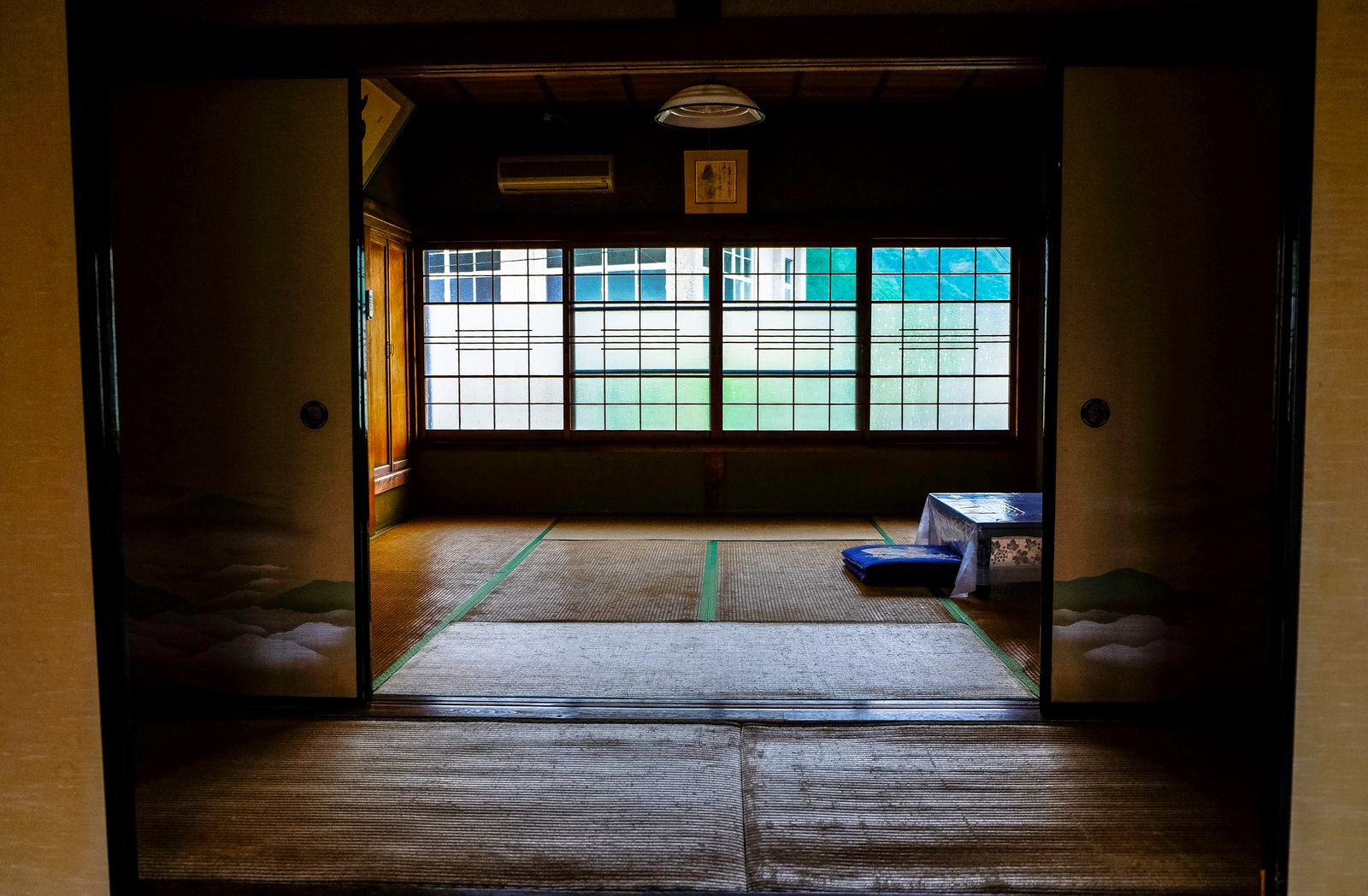
You slept on one in a ryokan, or in somebody’s spare room, and it worked. Now there is a listing open in another tab. That listing is for one object. The thing you slept on was not one object.
JbJ’s position, before the reasoning: settle where this will live during the day, and what goes under it and over it, before you choose the mat at all — and if your home has no answer to the first of those, the honest answer is that this purchase is not for you.
One thing to clear before any of that, because the English word is doing two jobs. The bare word mostly belongs to something else: the convertible sofa-bed, a frame that folds flat with a thick cushion on it, which stays in the room and is furniture. This page is about the other object — a mat that goes down on the floor at night and comes up in the morning, called 敷布団 (shikibuton) in Japanese. Same word in English, different purchase.
The mat is one item. The bedding you remember was a stack.
Think back to the room, if a room is where this started. Something under you. Something over you. Fabric between you and both of them, and something under your head. Every one of those has its own name in Japanese, and most of them have their own row in a Japanese regulation. The listing you have open is for one of them.
Japan does publish a primary list of what the word covers. It is not a lifestyle article — it is the labeling law.
布団 (futon) is a designated item — 指定品目 — under Japan’s textile quality labeling rules, administered by the Consumer Affairs Agency. The agency’s own product guidance spells out what that item takes in: 掛け布団 (the quilt over you), 肌布団 (a thinner one for summer), 敷布団 (the mat under you), ベッドパッド, こたつ掛け布団, 座布団 and かいまき — each of them qualified by the condition that fiber is packed inside.
Get that relationship the right way round, because it is easy to state backwards. 敷布団 is not the name of the designated item. 布団 is, and 敷布団 sits inside it. The list of designated items does not contain the string 敷布団 anywhere, which looks like an absence and is not one.
Then the part that bears on a purchase. Other things on a Japanese bed are designated too — separately, each in its own row: 敷布 (the flat sheet), 布団カバー (the futon cover), 毛布 (the blanket) and 毛布カバー (its cover), ベッドスプレッド, and 枕カバー (the pillowcase). Foam and spring mattresses are designated as well, under a different regulation entirely, which is the next section’s problem.
枕 — the pillow itself — is not on that list. The pillowcase is. That edge is worth carrying rather than smoothing: the rules designate the case and not the thing inside it.
That list is a labeling rule, not a shopping list — it tells you what a Japanese label must declare, not what a household owns. But read what it implies. The Japanese state does not treat this as one product. It names the parts separately, because they are separate purchases.
The listing sells you one of them. The list keeps going, and nobody selling you the mat is going to read the rest of it out loud. The whetstone guide found the same trick from another angle — the flattening plate nobody prices in. Same move: sold as a whole, delivered as a component.
Is the thing in the cart the object the word names?
The number every listing leads with
Thickness is the first figure on almost every listing, and it is where the shopping instinct goes. It is also the axis that settles the least. No official Japanese body specifies a standard thickness for one of these, and the mandatory Japanese label for a 布団 does not require thickness to be declared at all. The numbers you are comparing are the sellers’ own, and they do not agree with each other. That is the whole finding, and it is short on purpose.
The part a Japanese label has to name, and the part it does not
For a 布団 sold in Japan, the mandatory label is short. Two items: 繊維の組成, the fiber composition, and 表示者名等, the name and details of whoever put the label on.
The composition item is more specific than it sounds, and the specificity is the useful part. The regulation covers the fibers of the fill and the ticking — the fabric shell the fill sits in — with the proportion of each given as a percentage. Those percentages are ratios by mass, defined that way in the text itself. Not by volume. That is a different number and a common mistranslation.
Now the thing the rule does not require, because it is the claim you will meet about it. Japanese law does not make a futon declare how much fill is in it. There is no weight on the label. 質量 appears in the regulation only as the basis for working out the percentage. So the label tells you what the stuffing is made of, and never how much of it there is.
Where foam stops being the same product
Foam is a different category in Japan, under a different regulation. ウレタンフォームマットレス — urethane foam mattresses — are designated under the rules for miscellaneous industrial products rather than the textile ones, and the scope line for that category is bedding use with a foam section of 50mm or more at its thickest.
What that category has to declare is a much longer list than the futon’s: material, structure, dimensions including thickness in millimeters or centimeters, firmness in newtons, recovery rate, the composition of the cover fabric, cautions for use, and the labeler.
Put the two lists side by side and the inversion is hard to miss. Thickness, the number the English market leads with, is compulsory for the foam product and not required for the futon at all.
Say what that is and is not. It is a statement about which Japanese labeling category a product falls into. It is not a statement about which one is better, softer, firmer or longer-lasting. Nothing here tested that, and nothing here is claiming it.
And none of it follows the product out of Japan
Everything above binds goods sold into the Japanese market. Imports are explicitly included — an importer selling into Japan labels to the same standard a domestic maker does. Nothing extends the obligation outward. A futon bought in the US, the UK or Canada is labeled under that market’s own law, and none of the Japanese declarations is guaranteed to be on it.
Which makes the Japanese rule a reading tool rather than a guarantee — the same boundary the rice and cooker page runs into from the other end. It is good for two things. On Japanese-market stock, the panel has to be there. And everywhere else, it is the thing to ask for, because whether a listing publishes a composition breakdown is a decision somebody made.
| 敷布団 — as the word names it in Japan | A foam floor mattress sold in English as a “Japanese futon” | The US convertible sofa-bed that owns the bare English word | |
|---|---|---|---|
| What the object is | A fiber-filled mat; one item inside the designated item 布団 | A urethane foam slab in a fabric cover | A frame that folds flat, with a thick cushion on it |
| Where it is when nobody is asleep on it | Down for the night, up again after; where it goes then is not part of what you bought | Also a floor product; storage is left to the buyer either way | In the room. It is the sofa |
| What else has to be there before it is a bed | A cover, a sheet, something over you, something for your head and a case for it — and somewhere for all of it to go by day | The same list. What the listing covers is the mat | Nothing else. The frame and the cushion are the bed |
| What a Japanese label must declare, for goods sold in Japan | 繊維の組成 — the fibers of the fill and the ticking, as percentages by mass — plus the labeler’s details. Nothing further | Material, structure, dimensions including thickness, firmness in newtons, recovery rate, cover composition, cautions, labeler. The foam category starts at 50mm of foam | A different product in a different market. Not what you came here for |
Row four describes obligations on goods sold into the Japanese market, imports included. A product bought outside Japan carries none of them.
JBJ'S TAKE
Ask what is inside it. Ask before you pay.
The word on a listing is free. The composition is not — in Japan it is a printed obligation, and outside Japan it is whatever the seller decides to publish. So the question that separates these objects is not whether something is authentic. It is what is inside it, and in what proportion by mass.
JbJ would send exactly that question and treat what comes back as the answer. A seller who can tell you the fill and the ticking is describing a product. A seller who answers with a country, a tradition, or the word traditional is describing a category of feeling, and the difference is checkable before any money moves.
A refusal counts too. Nothing outside Japan obliges anyone to publish that breakdown, which is precisely why a seller who publishes it anyway has told you something — and one who will not has also told you something.
Where it goes when it is not on the floor
Here is the part the listing will never show you: the equipment a Japanese home keeps around this thing.
押入れ (oshiire) is the deep built-in closet with a shelf across the middle. It is where the bedding goes during the day, and it is the reason a Japanese room can hold a bed without containing one. すのこ (sunoko) is a slatted platform that sits between the bedding and the floor. 除湿シート (joshitsu shīto) is a sheet that goes underneath. 布団乾燥機 (futon kansōki) is an appliance that blows warm air into bedding — a whole product category, sold in every electronics shop in the country, that exists because this equipment has to be dried.
Read that last one again, because it is the tell. A market does not build an appliance category around a chore nobody has to do. The futon is not a mat you buy. It is a mat you operate, and Japan has been quietly selling the tools for it the entire time.
And if you are outside Japan, the first item on that list is architecture. You cannot order it. That is not a small detail — it is the one part of the arrangement your home either already has or never will.
How common is this, and what Japan actually counts
A fair question at this point is whether this is how people in Japan sleep. The honest answer starts with who is doing the counting.
Here is a detail that says more than any survey. Japan’s national household survey counts 「ベッド・ソファーベッド所有数」 — how many beds and sofa beds a household owns. There is no futon line. The state counts beds.
Which tells you where the country actually went. Every number you will see quoted on this question comes from a private commercial panel, not a government count. A 2022 LINE Research panel put it at about 60% bed people, just over 30% futon people. A 2016 Planet panel put it at 47.3% futon, 51.9% bed. Different companies, different questions, six years apart — two snapshots, not a trend line.
So be clear-eyed about what you are buying. This is not how most of Japan sleeps anymore. It is a deliberate choice, made by people who want the floor back during the day and are willing to do the work that buys it.
Your floor, your drying arrangement, your morning
Your floor
The question: what is going to be underneath this, and can you look at it?
You will find a lot of confident tables ranking floor surfaces by risk — tatami safest, then hardwood, then laminate, carpet worst. Read four of them and you get four different orders. They contradict each other, and none of them is measuring anything.
Ignore the rankings. They are not the variable. Bedding on a solid surface with no air under it, left flat all day, is the problem — and that is true on tatami as much as on laminate. What decides it is not what your floor is made of. It is whether air can get underneath, and whether the thing comes up in the morning.
Which turns an unanswerable question into a cheap one. Put a slatted base under it, and lift it daily. Do that and the floor stops mattering much. Skip both and no floor surface will save you.
Where it dries, and whether your building allows it
The question: if this is going to be aired or dried at all — and the market plainly assumes it will be — where would that physically happen?
You can answer that at home in about a minute, and it is worth answering before rather than after. Is there a balcony, a rail, a yard, a window that opens onto something usable? Does your lease or your building association permit hanging items over a balcony rail, and have you actually read that part? If the building is shared, has anyone?
You do not need a number for this. A body puts moisture into bedding every night, the bedding has to give it back somewhere, and if the answer is “nowhere” you will find out in about a season.
The part that happens every morning
The question: are you going to do this on the mornings you do not feel like it?
A floor futon comes with a daily handling step attached. It goes up, it goes somewhere, and that happens when you are late as well as when you are not.
A 2016 Planet panel asked people in Japan how they care for their bedding. Airing it outdoors was the most common answer, at 54.8%. And 70.8% said they were not confident they knew the right way to do it.
Sit with that. Seven in ten owners, in the country this equipment comes from, are unsure of the routine — and every schedule you will find online traces back to somebody selling a futon, a cleaning service, or a dryer.
So stop hunting for the correct interval. There isn’t one, and the people insisting otherwise are selling something. Get it up off the floor in the morning and get air to it when the weather allows. That is the whole practice, and it is enough.
JBJ'S TAKE
Two of those three are yes or no.
This is the part of the page that is allowed to end in no, so here it is as a rule. If there is nowhere in your home for the bedding to go during the day, and nowhere it could be aired if you wanted to, JbJ would not buy this. Nothing to do with the product. You would be buying one component of an arrangement whose other components your home does not have.
The morning question is the one people answer wrong about themselves. It is not a preference and it is not a habit you grow into. It is a handling step attached to the object, and the moment to be honest about it is now, while nothing has been spent.
And ignore your floor type. Everyone wants that to be the deciding question because it is the one you can answer without changing anything about your life. It isn't. Air underneath and a lift in the morning beat any floor surface, and no floor surface survives skipping both.
If you are still buying: what to settle before you choose a mat
Say the gate went the other way. Then the order of operations is not the one the listings imply, because the listings start at the mat.
Price the arrangement, not the mat. Before you buy anything, write the full list: something under, something over, a cover for each, something for your head and a case for it, a slatted base, and somewhere it all goes by day. Now price that. The number will not resemble the number on the listing, and that gap is the entire reason this purchase disappoints people. Build the list first and you will make this decision once instead of five times.
Decide which object you are buying before you compare. A fiber-filled mat and a urethane foam slab are different Japanese labeling categories with different mandatory declarations, and both are sold in English under the same phrase. Pick the category first. Comparing across the two is comparing answers to different questions.
Ask for the composition, and ask for both halves of it. The fill and the ticking, as percentages by mass. Outside Japan nothing obliges a seller to publish that, which is exactly why the asking is worth doing, and why the answer — or its absence — tells you what kind of seller you have.
Do not shop on thickness. Japan does not require a futon to declare one, no standard value exists, and the numbers you are comparing are marketing. Every inch a seller adds is an inch of argument for a higher price, not evidence of a better product.
Leave the pillow for last, and spend little on it. It is the one part of the stack Japanese labeling rules do not cover — the case is regulated, the pillow itself is not. There is no declaration to read, so buy the cheap one, sleep on it, and replace it when you know what you actually want.
Who should not buy this
Anyone shopping for a back cure. The English-language futon market sells posture and spinal alignment hard, and a Japanese manufacturer sells the exact opposite claim — that hauling bedding around daily is good exercise in later life. Both are marketing. Buy this because you want your floor back during the day, not because a listing told you what it would do to your spine.
Anyone who wants to be handed a model number. There is no best futon and there is no ranking here, because the decision is not which mat. It is whether your home can run one.
Anyone whose honest answer to the morning question was no. Not a character flaw. It is a compatibility problem, and a bed solves it for less money and less argument.
The matcha page draws the same line on a different product, and the kitchen knife guide covers how to tell a buying guide from a sales page — worth five minutes before you spend real money on anything Japanese.
JBJ'S TAKE
Buy the arrangement, or buy nothing.
If your home answered the three questions — somewhere for it to go, somewhere it could be aired, and a morning you are honest about — then buy, and buy in the order above. Build the list of what has to be in the room, price that list, and choose the mat last. The mat is the part carrying the marketing and the smallest share of the decision.
If your home did not answer them, the move is not a cheaper mat. It is a bed, or nothing. JbJ would rather say that than sell you the first component of something you cannot finish.
Still undecided? The next step costs nothing. Ask a seller what the fill and the ticking are made of, by mass. What comes back settles more than the listing did.
Checked 3 September 2026. Labeling rules, designated items and the urethane foam category: Japan’s Consumer Affairs Agency. Household bed-ownership figures: the national statistics portal. Usage and care figures: the survey publishers’ own releases, with fieldwork years given above.
FAQ
Is a Japanese futon the same as a futon sofa bed?
No, and the English word is why people ask. The convertible sofa-bed — a frame that folds flat with a thick cushion on it — owns the bare word in American English, and it stays in the room as furniture. A Japanese floor futon is the other object: a fiber-filled mat that goes on the floor for the night and comes up again, called 敷布団 (shikibuton) in Japanese. One word, two entirely different purchases.
Can you put a Japanese floor futon on carpet or a hardwood floor?
Yes — but the floor is the wrong thing to worry about. The ranked tables you will find contradict each other, and none of them is measuring anything. What actually decides it is whether air gets underneath and whether the bedding comes up in the morning. Put a slatted base under it and lift it daily, and carpet is survivable. Skip both and tatami will not save you.
What comes in a Japanese futon set?
Japan has a primary list, but it is a labeling list rather than a shopping list. Under the textile quality labeling rules, these are separately designated items: 布団 (which takes in 敷布団, 掛け布団 and others), 敷布 (flat sheet), 布団カバー (futon cover), 毛布 and 毛布カバー, ベッドスプレッド, and 枕カバー (pillowcase). The pillow itself is not designated; its cover is. That tells you what must be declared on goods sold into Japan — not what a household owns, and not what you have to buy.
Do people in Japan still sleep on futons?
Both usable numbers come from private commercial online panels, and neither is a government statistic. A 2022 LINE Research survey of the app’s own users reported about 60% describing themselves as bed people and just over 30% as futon people. A 2016 Planet survey reported 47.3% futon and 51.9% bed. Different companies, panels and questions, six years apart — two snapshots, not a trend. No Japanese government statistic measuring this was found; the registered household item counts beds.