You bought one Japanese knife. Now you are looking at a wall of stones numbered from 220 to 12000, and every guide wants to sell you three of them.
Buy one stone around #1000. That is the answer for almost everyone reading this, and the rest of this page is about when it stops being the answer.
The number is not a certified figure
Start here, because it changes how you read every listing.
There is a Japanese Industrial Standard for abrasive grit — two of them, in fact, both established in 2017. What they standardize is the size distribution of loose abrasive grain. Not the finished stone. Not the number printed on its box.
No JIS-mark scheme for kitchen whetstones exists, so a consumer sharpening stone’s printed number is not certified or audited against that standard. It is the maker’s own figure.
But do not swing to the other conclusion either. One major maker publishes its own micron figure beside every grit it sells, and those figures track the JIS series almost exactly up to #8000. The numbers are not invented. They are a convention that mostly holds — which is a different thing from a certification, and worth knowing before you pay a premium for a decimal point.
Where it actually breaks: the same number, twice the grit
This is the part that costs people money.
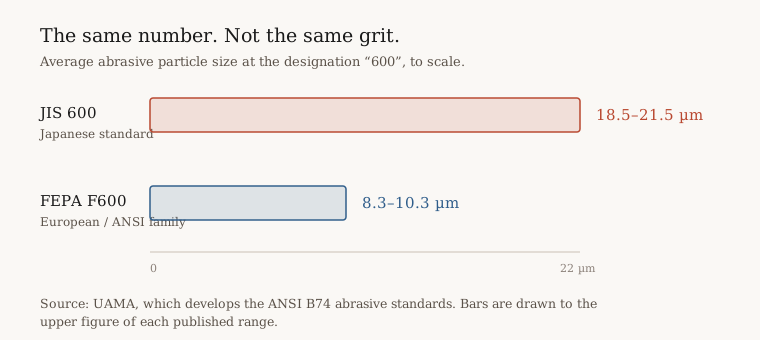
The body that develops the ANSI abrasive standards states it plainly: the same size number can refer to very different sizes depending on which standard is being used. Its worked example is exactly the one that matters here — a JIS 600 averages 18.5–21.5 microns, while a FEPA F600 averages 8.3–10.3.
And it holds from both directions. A Japanese abrasive manufacturer publishes F600 at 9.3 ± 1.0 µm, which lands inside the ANSI body’s range for the same designation. Two independent bodies, the same answer.
So a Japanese # number and a European F number are not interchangeable, and any conversion chart that treats them as equivalent will steer you wrong. Buy within one system, or read the micron figure instead of the number.
And above #8000, the scale simply stops
The JIS microgrit series runs to #8000 and ends there.
Stones are sold at 10000, 12000, 16000, 30000. Those numbers sit outside the standard’s series entirely.
You can watch a manufacturer arrive at that boundary. One maker’s own product table gives a micron class for every stone from 320 through 8000 — and for its 10000 and 16000 stones prints no micron figure at all, substituting a word. The maker stops publishing a number at exactly the point the standard stops defining one.
The category words are not specifications either
Coarse, medium, finishing sound like grades. They are trade vocabulary, and makers do not agree.
#1000 is labeled three different ways across current catalogs: one calls it medium-finishing, two call it simply medium, and another line from the same company sells the same grit as a medium-coarse.
And one maker contradicts itself at a single number. Its deluxe #6000 is sold as super-finishing; its finishing series, also at #6000, is sold as finishing. Same company, same grit, two categories.
If you have read our knife article, this will sound familiar. No Japanese Industrial Standard sets blade length by knife name either. The pattern is the same: a word that sounds like a specification, doing the work of a category label.
JBJ'S TAKE
Read the micron figure. Ignore the adjective.
A number is at least a convention. "Medium" is one company's shelf label, and the company down the road uses it for something else.
So when a maker publishes microns, trust the microns. When it doesn't — that tells you something too.
So what do you actually buy
Most guides go quiet exactly here. This is the whole list.
One stone, around #1000. For a home cook with one double-bevel knife that is not chipped, this does the whole job. It removes enough metal to restore an edge and leaves a finish that cuts vegetables and protein perfectly well.
A flattening plate, bought at the same time. This is the accessory nobody prices in, and it is not optional. Three separate manufacturers state that a stone must be kept flat to sharpen correctly, and one warns plainly that a stone worn hollow in the middle is dangerous, because the edge catches. A dished stone does not sharpen worse — it sharpens wrong.
Nothing else, yet.
You need a coarse stone only if you have actually chipped the blade. If you bought the knife recently and have not dropped it on tile, you do not have that problem, and a coarse stone will spend years in a drawer. You need a finishing stone only once you can reliably produce a good edge on the #1000 and can tell that you want more. That threshold is real, and it arrives later than the shop suggests.
One maker does publish a beginner recommendation. It suggests a #1000 plus a #5000, or a single #1500 if you want one stone. That is a manufacturer’s recommendation for its own range, which does not make it wrong — but it is not a neutral source, and no neutral source exists.
JBJ'S TAKE
Every party who will tell you what to buy also sells stones.
That is the actual gap. Not silence — nobody is hiding anything. There is simply no disinterested authority on how many stones a home cook needs.
JbJ sells none, so: one stone and a flattener. Add the second when the first one stops being the limit. Most kitchens never get there, and that is fine.
Water, and the one instruction that is genuinely per-product
There is no universal soaking time, and pages that give you one are guessing.
The makers differ, legitimately, because the stones differ. One states that its stones do not need soaking — except five or six minutes before first use — and caps immersion at thirty minutes, warning that longer softens the stone. Another asks for ten to twenty minutes, until the bubbles stop.
Both are correct about their own products. Neither transfers.
So the instruction is: read the box your stone came in. That sounds like a non-answer and it is the only honest one. Soaking times circulate online for several well-known brands that those makers do not publish anywhere — so the box in your hand outranks anything you will read about your stone, including here.
Two things not to carry over from elsewhere
Search 砥石 安全 in Japanese and you will land on industrial safety law — mandatory trial-running periods, guards, ring tests, protective equipment, formal worker training. None of it applies here. That regime governs powered grinding wheels, and the companies publishing it make industrial cutting discs, not kitchen bench stones.
Natural stones do not have a grit number. They are not manufactured to one, so any “equivalent grit” printed beside a natural stone is somebody’s estimate dressed as a measurement. There is no official definition separating natural from synthetic, and no whetstone appears among Japan’s designated traditional crafts at all — not even on Kyoto’s own list of seventeen, in the prefecture most associated with natural finishing stones. Treat “traditional” on a natural stone as marketing, and pay for the stone, not the story.
Before you go
Buy the #1000. Buy the flattener. Keep the box, because it has the soaking instruction on it and no website can tell you that reliably.
And if you are shopping outside Japan, check whether the number on the front is a JIS number or an F number before you assume it matches the one you already own.
Checked 2026-09-02. Grit standards and their scope come from the Japan Standards Association’s published records; the cross-standard particle sizes from UAMA, which develops the ANSI B74 abrasive standards, corroborated against a Japanese abrasive manufacturer’s own published figures; the grit-to-micron table, category labels, soaking limits, flattening guidance and beginner recommendation from the manufacturers’ own official documentation; craft-designation status from the national promotion body and Kyoto City.