You are about to spend real money on one knife, in a vocabulary you do not have yet, guided by pages that mostly belong to people who sell knives.
That last part is not an accusation. It is just the shape of this corner of the internet, and it is worth knowing before you take anyone’s advice — including what follows.
So: four decisions, in order, and only the first two carry real weight.
The short version
- Blade type and steel are the knife. Handle and price matter, but they are hard to get badly wrong once the first two are right.
- One good knife beats a set. A block of eight is seven knives you will not sharpen.
- Santoku or gyuto, either is a safe first buy. Deba and yanagiba are excellent and are not first knives.
- Stainless unless you will genuinely keep up with carbon. Not a compromise — a different bargain.
- Buy a tier, not a number. Middle, not the floor and not the showpiece.
The words you need first
Gyuto (牛刀) — literally “cow sword.” The Japanese take on a Western chef’s knife. Long, with a curved belly you can rock.
Santoku (三徳) — “three virtues,” usually read as meat, fish and vegetables. Shorter, flatter, with a rounded tip.
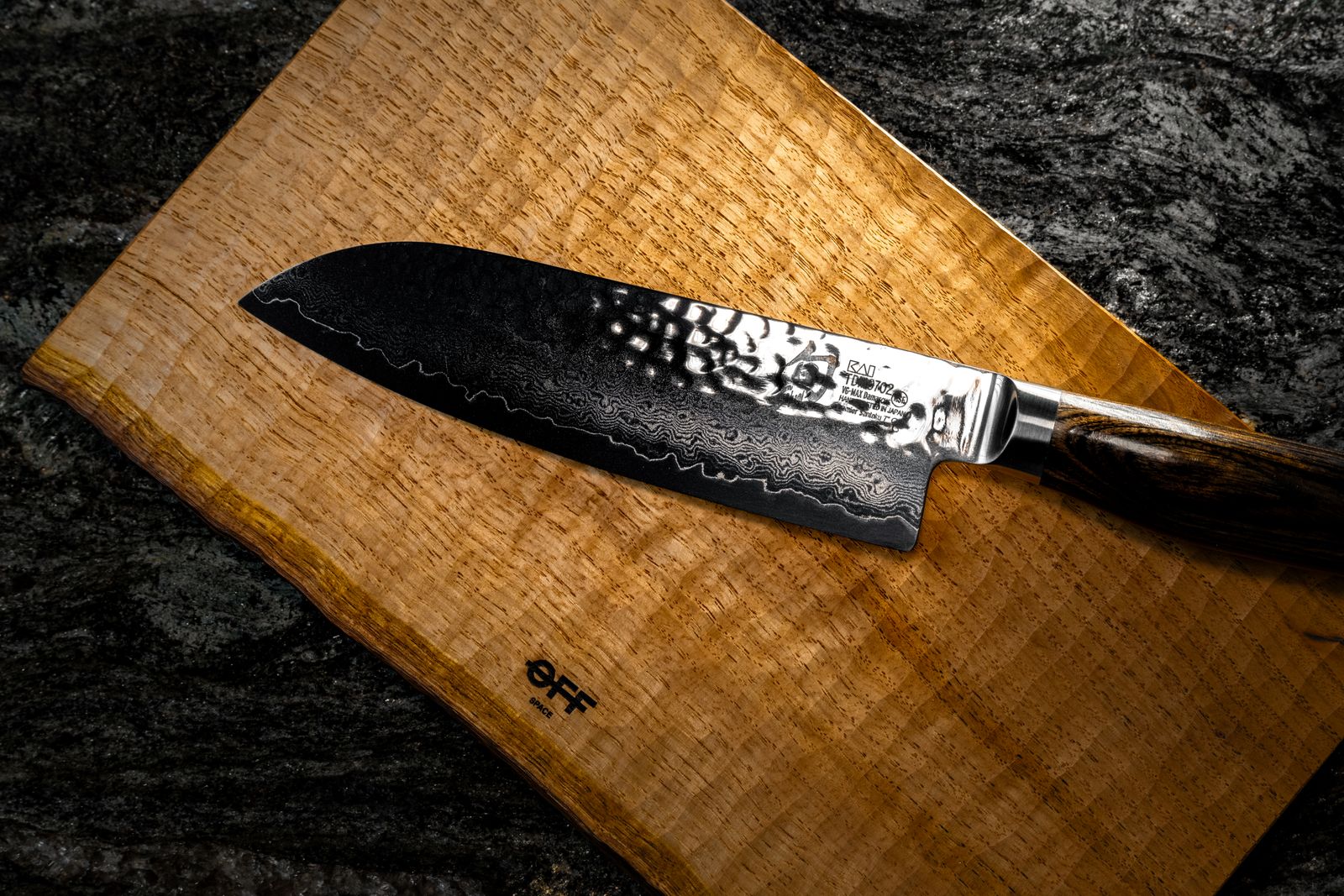
Bunka (文化) — close enough to a santoku that Sakai Ichimonji Mitsuhide’s own catalog treats the names as near-synonyms. The visible difference is the angled tip.
Nakiri (菜切り) — “vegetable cutter.” A flat rectangle. Wonderful, and single-purpose.
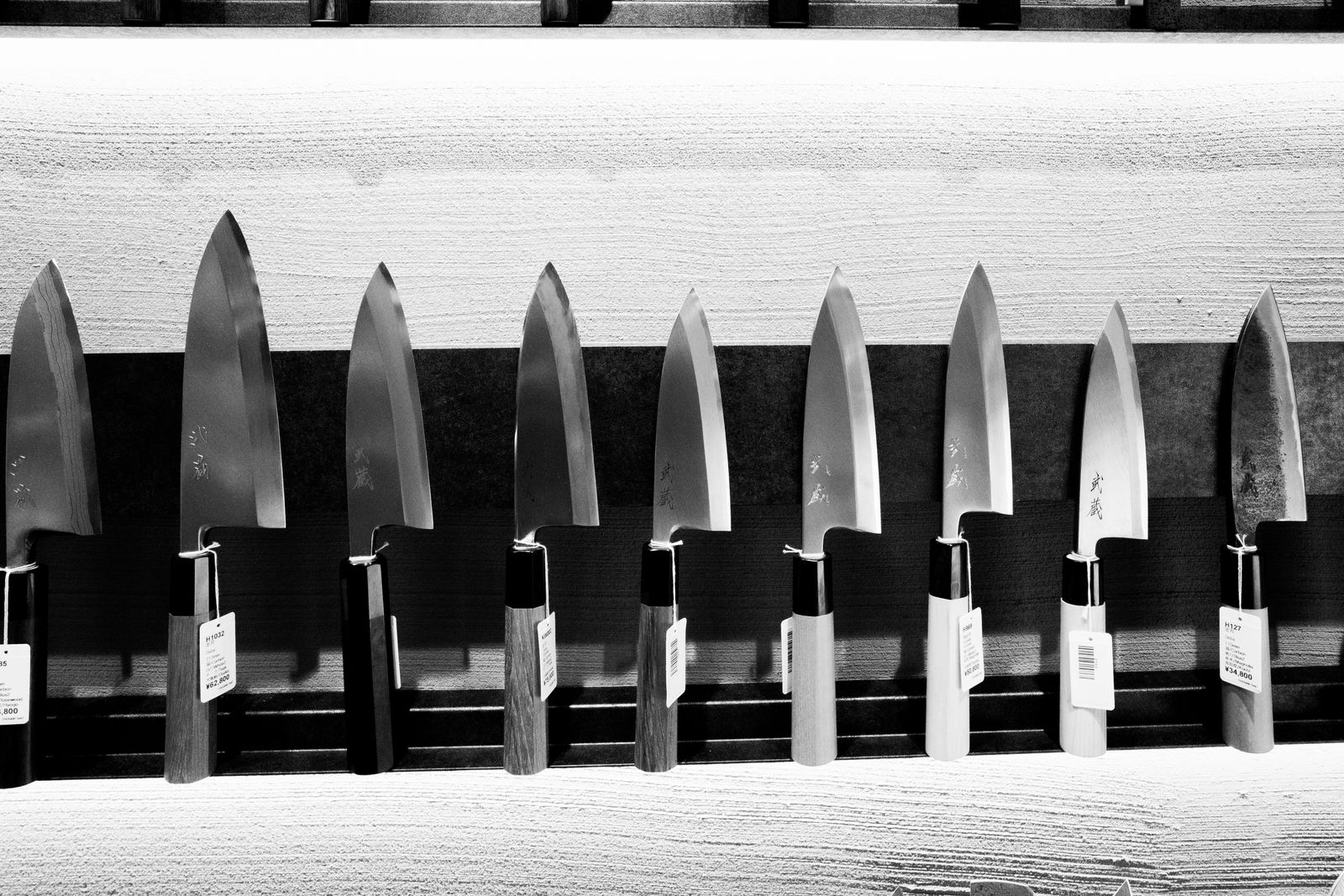
Deba and yanagiba — fish butchery and sashimi slicing respectively. You will see both recommended constantly. Neither is a first knife.
Decision 1: which blade type
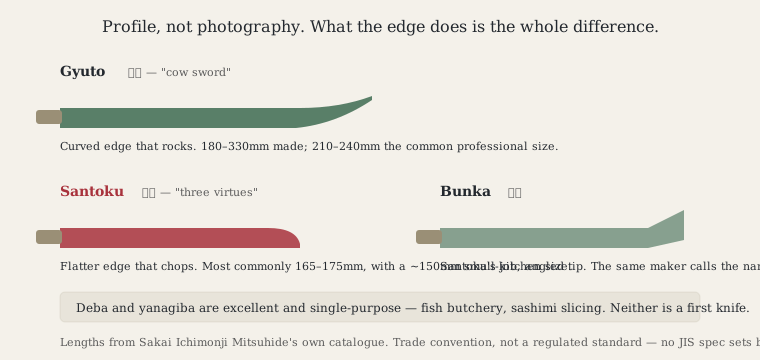
Gyuto and santoku are both safe. The guides that rank for this question broadly agree on that, and so does this one.
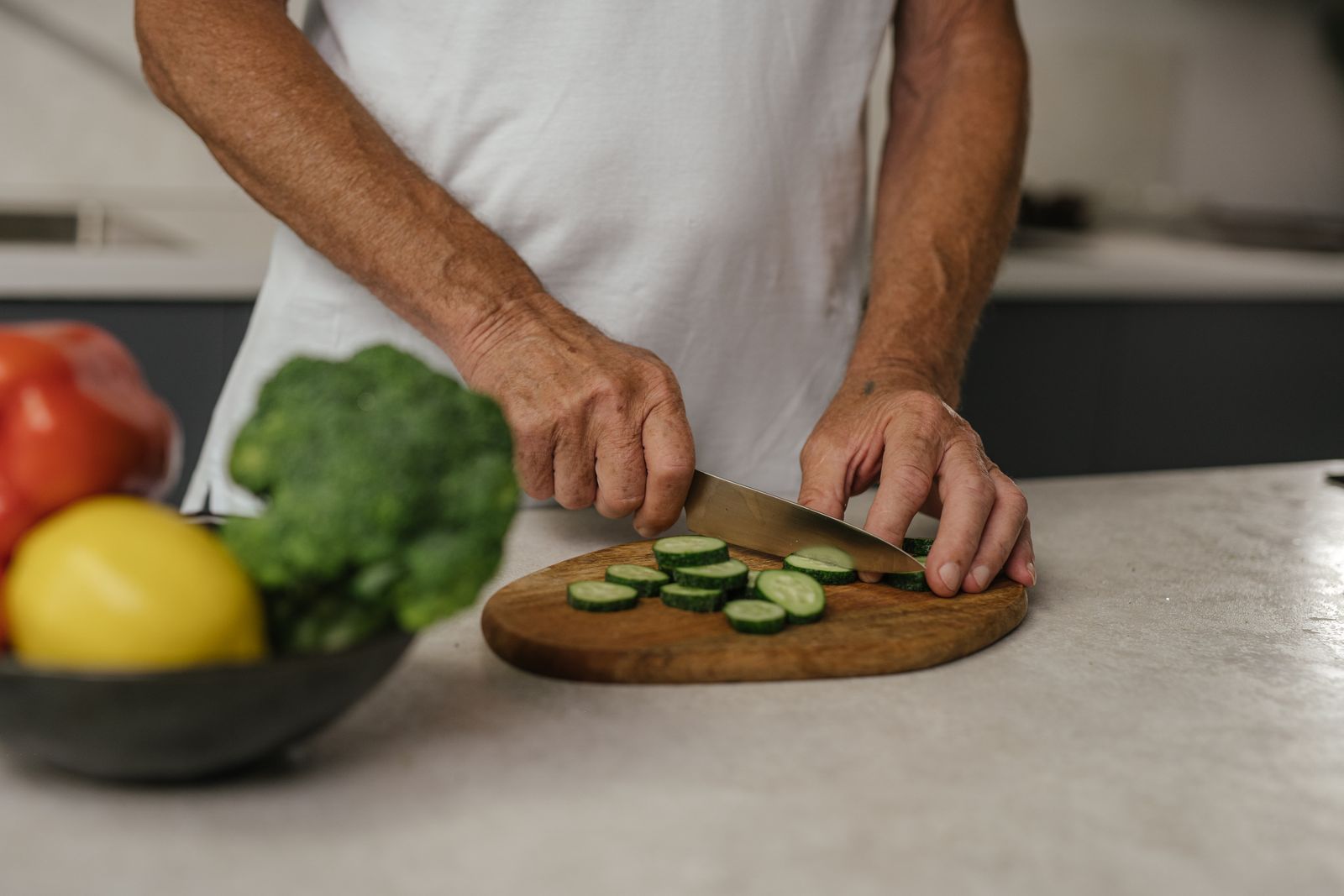
Gyuto is made from 180mm to 330mm in 30mm steps, per the maker’s catalog: 180–210mm is the household range, 210–240mm the most common professional size, and above that you are into volume prep. The curved edge suits a rocking motion.
Santoku is most commonly 165–175mm, with a roughly 150mm version for small kitchens. The flatter edge suits a straight up-and-down chop, which is what most home cooks do anyway without being taught to.
Bunka does the santoku’s job with a pointed tip that is genuinely useful for detail work.
Those lengths come from Sakai Ichimonji Mitsuhide’s own catalog rather than from a retailer’s blog. Worth knowing: no Japanese Industrial Standard sets blade length by knife name. These are trade convention, which is why you will see ranges rather than specifications.
Decision 2: which steel
Stainless resists rust. It survives being left wet on a Tuesday. It takes a very good edge and not the finest one.
VG-10 is the name most worth learning, because you will meet it constantly. It is made by Takefu Special Steel, and the manufacturer’s own page puts it at 15% chromium — comfortably stainless — with a rated hardness of HRC 60 or higher. You will also see AUS-8 and SG2; both are real, both are fine, and the marketing around all three runs well ahead of what any maker actually claims.
Carbon takes and holds a finer edge, and develops a patina that is genuinely part of the appeal. It will also rust if you walk away from it wet.
JBJ'S TAKE
Do you want the steel, or the idea of the steel?
A quick gut check before carbon wins you over: are you drawn to the steel, or to the idea of it? The patina, the ritual, the sense of a blade with more character than a stainless one — none of that's fake, and none of it makes carbon the wrong choice. It's a real trade-off, not a downgrade.
But it does ask something ongoing of you that stainless doesn't. If you already know, honestly, that you won't keep up that end of the bargain, that's not a failure — it's useful information.
Take the stainless, and don't feel like you settled for it.
Decision 3: handle and look
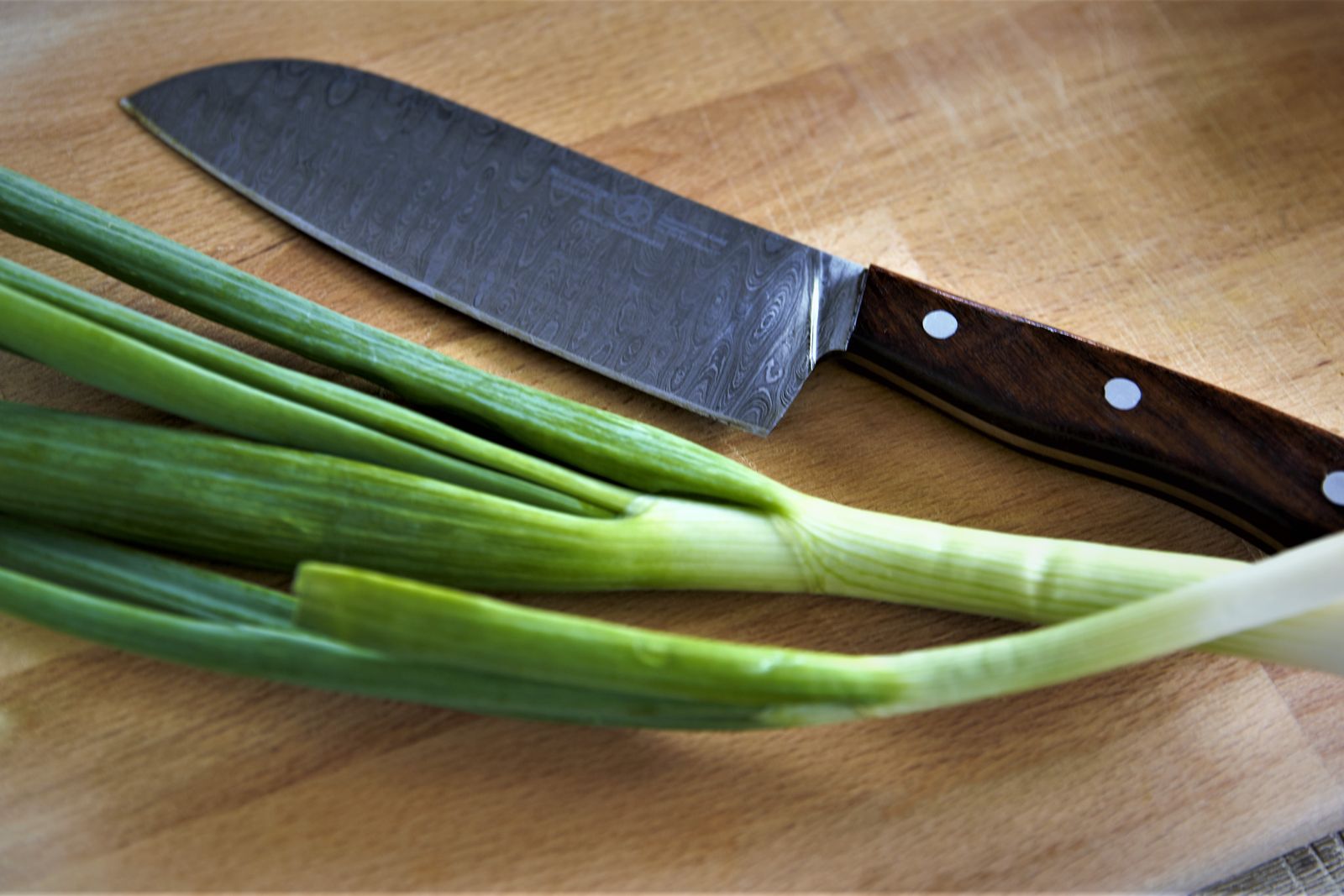
Two shapes. A Western handle, riveted and contoured, and a wa handle — the Japanese style, usually octagonal or D-shaped wood, lighter and further back on the blade.
People will tell you this changes everything. It changes how the knife feels in your hand, which matters, and which you cannot determine by reading. If you can hold one before buying, do. If you cannot, either is fine, and this is the decision least worth agonizing over.
Damascus cladding — the rippled pattern — is a look. It is not a performance claim.
Decision 4: what you pay
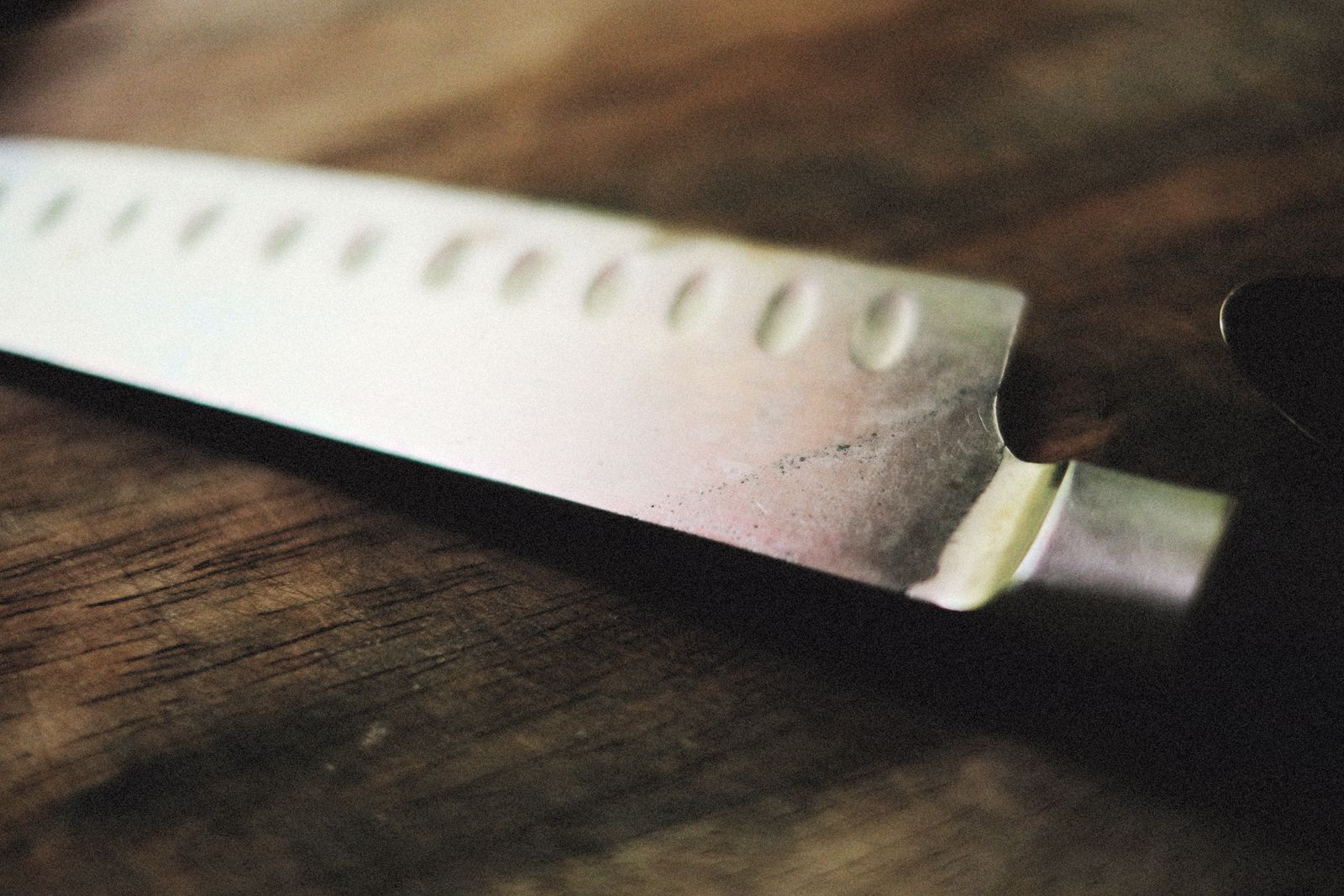
Three tiers, and deliberately no figures — knife prices move with steel, maker and exchange rate, and any band printed here would be wrong somewhere by the time you read it. Shop the tier, not the number.
The entry shelf is cheap enough to be a gift and thin enough that the edge is the thing you notice. The middle is a knife bought to be used for years. The craft tier is a named smith and real provenance — a wonderful second knife.
One good knife beats a set
The block of eight on the shelf is a set of seven knives you will never sharpen and one you will use until it goes blunt.
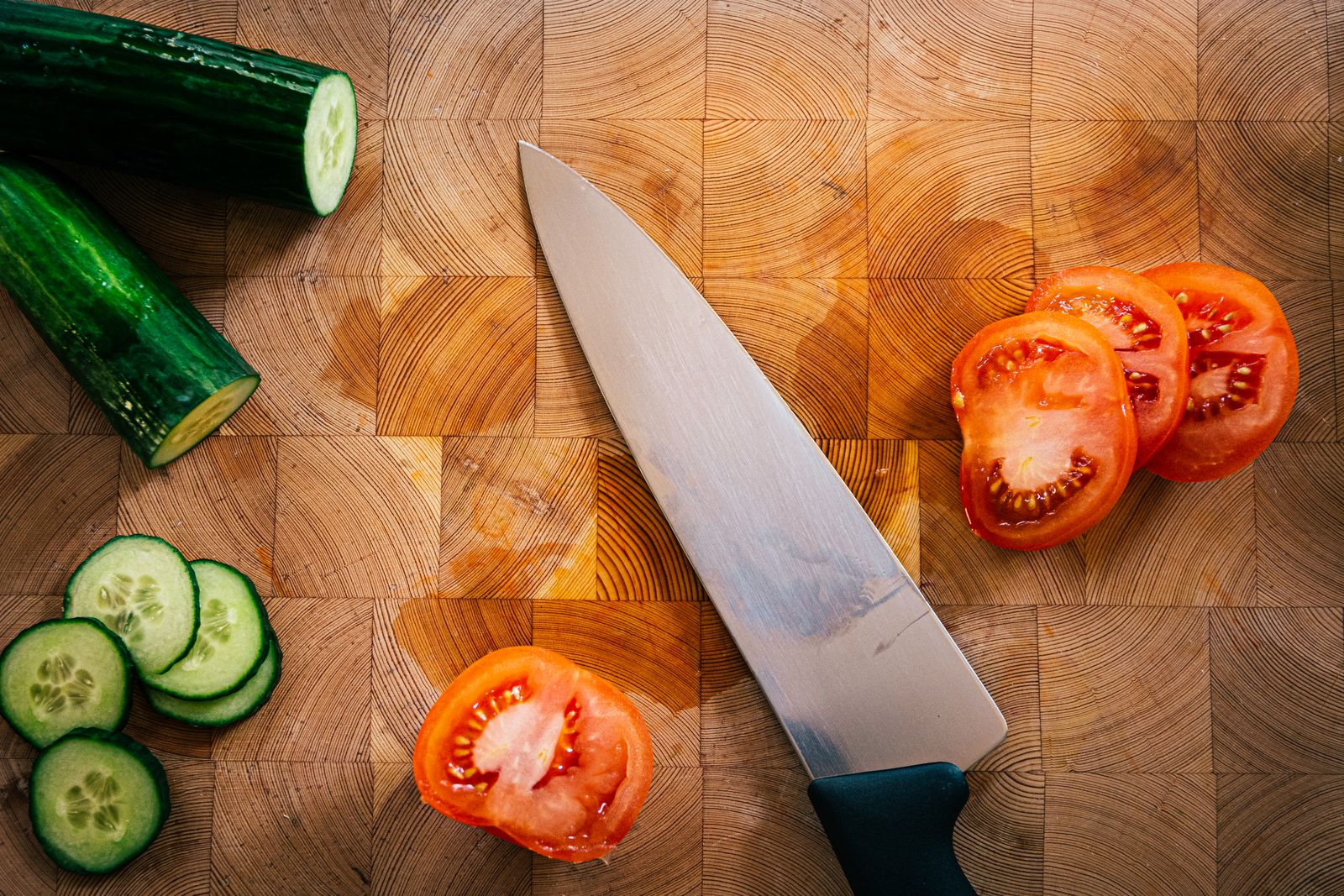
Buy the one. Learn what a sharp knife actually feels like. Then decide whether you want a second, which by then you will be able to choose without a guide.
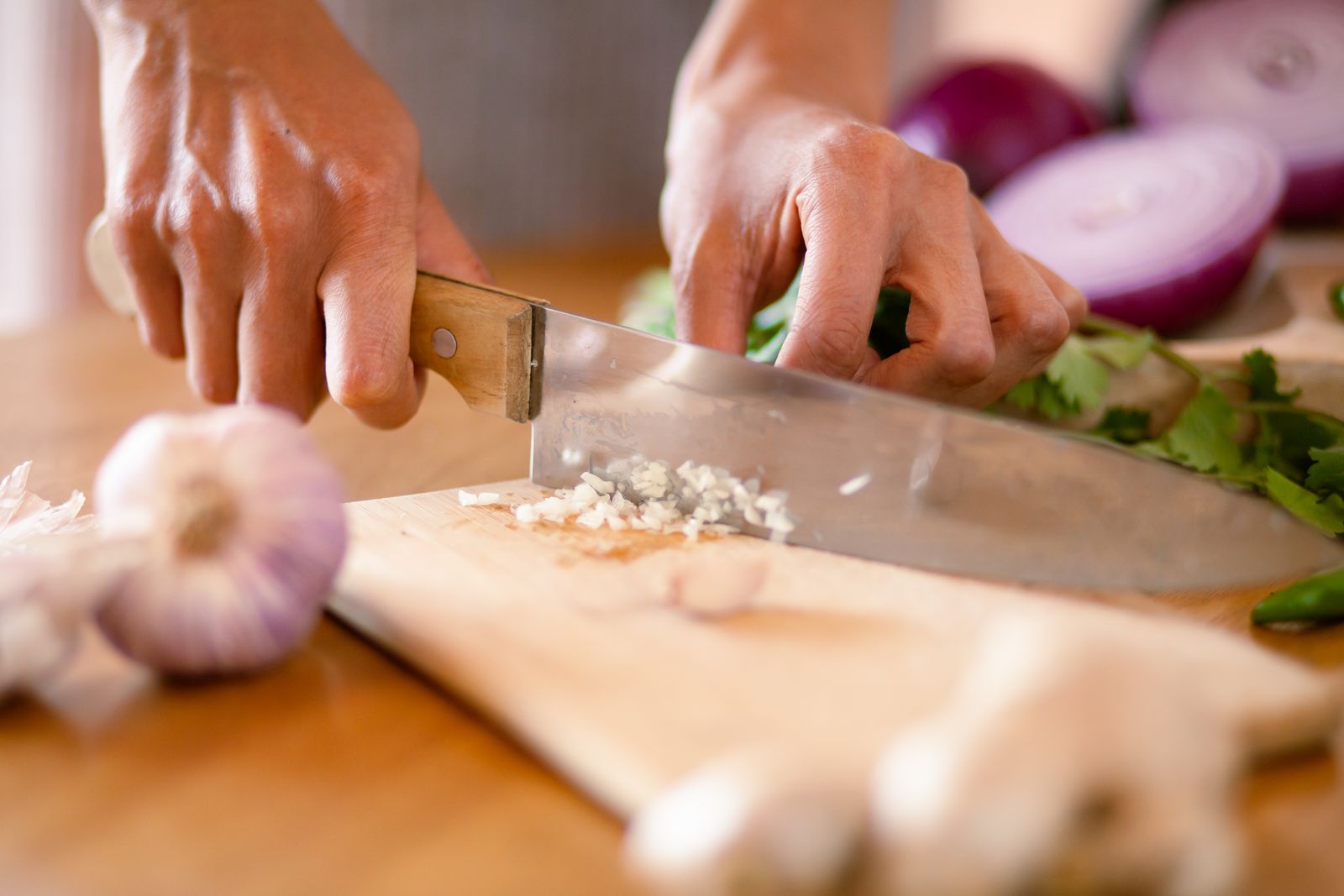
So, which one should you get?
JBJ'S TAKE
A stainless santoku, middle tier.
If you're making JbJ pick one, here it is: a stainless santoku, priced in the middle tier — not the floor, not the ceiling.
Santoku over gyuto, for one specific reason: the name says the job. 三徳 — "three virtues" — meat, fish, vegetables, one blade, which is exactly what a first knife with no second knife waiting behind it needs to do. Gyuto grew into that same versatility over time, but it started life as a beef knife — 牛刀, literally "cow sword." For a genuinely single first purchase, JbJ backs the one that was built for everything from the start. To be clear about where that comes from: the sources agree both types are safe first buys and rank neither above the other. Choosing santoku is this publication reading those facts, not reporting someone else's verdict.
Stainless, because a first knife should survive a rushed weeknight. VG-10 is a name worth learning: a Japanese stainless steel the maker rates for good corrosion resistance and real edge retention, hard enough — HRC 60 and up — to actually hold a line.
Middle tier on price, not the cheapest shelf and not the artisan showpiece. You're buying one knife, not starting a collection — spend enough to get it right the first time.
How to tell a buying guide from a sales page
JBJ'S TAKE
Eleven of twelve first-knife guides sell knives.
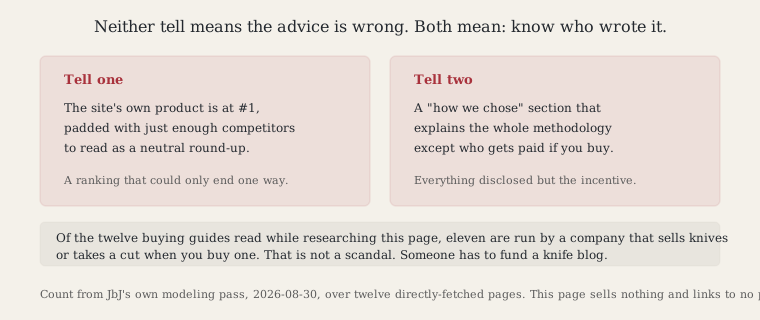
Here's the honest version of this section, the one most of the guides above don't write: eleven of the twelve buying guides JbJ read while researching this page are run by a company that sells knives, or takes a cut when you buy one. That's not a scandal — someone has to fund a knife blog — but it means the "best pick" at the bottom of most of those pages was never a neutral conclusion. It was always going to point somewhere.
JbJ isn't selling you a knife. There's no product link on this page, and no affiliate deal behind it — not because JbJ is above that, but because none exists yet in this category.
That doesn't make JbJ smarter than the guides above — it makes this page's incentive different, and that's worth knowing before you trust anyone's "best of" list, including a future one from JbJ.
Two tells worth carrying with you after this page. A "best of" list where the site's own product sits at the top, padded with just enough competitors to look neutral. And a "how we chose" section that explains the whole methodology except who gets paid if you buy the pick. Neither means the advice is wrong. It means you should know who wrote it before you follow it.
Basic care, before you skip carbon out of fear
Wash it by hand and dry it. Not the dishwasher — heat, detergent and knocking against other steel are all bad for an edge, and worse for a wooden handle.
Keep it off ceramic and glass boards. Wood or a soft composite.
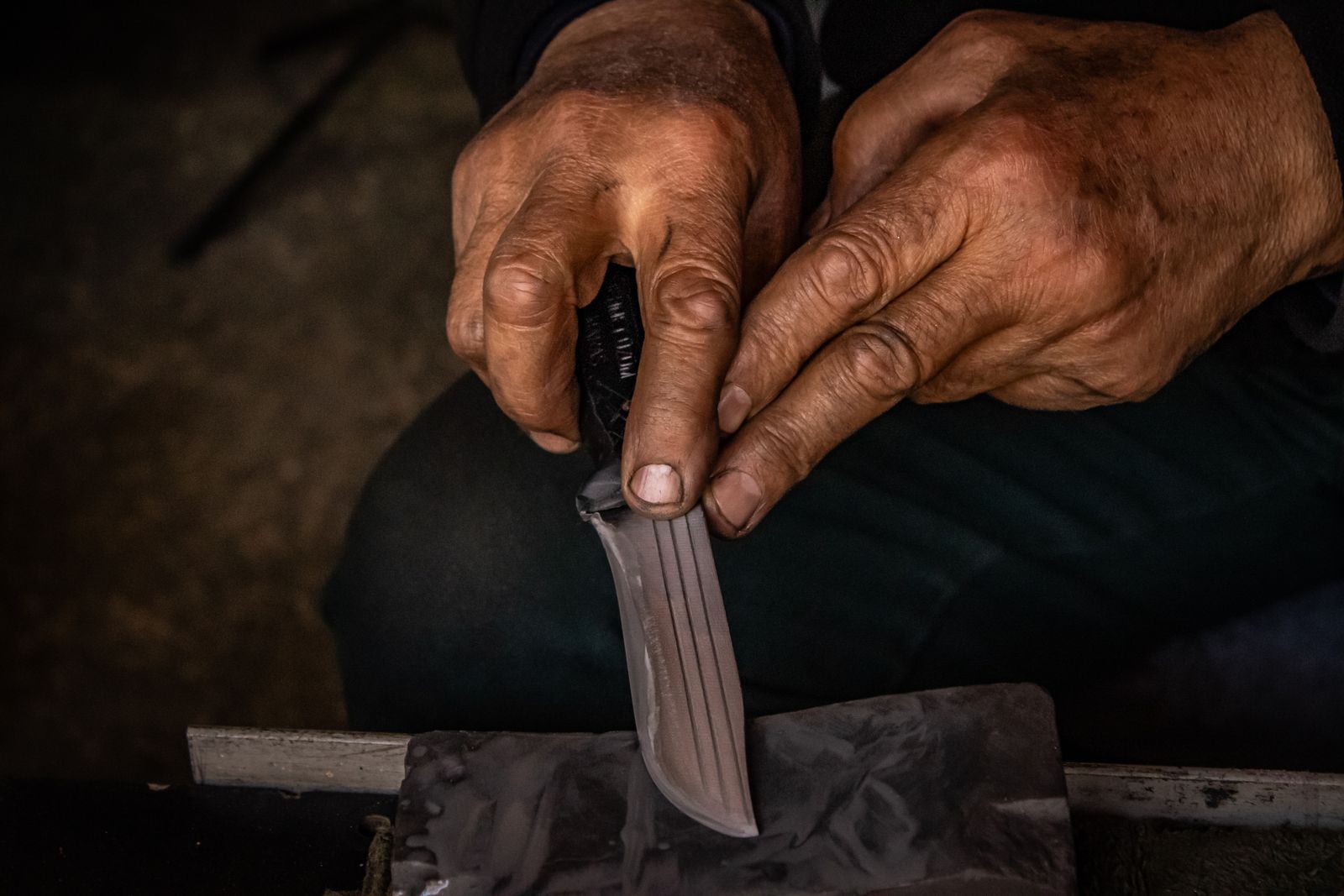
It will need sharpening. A knife that has never been sharpened is a knife that has been slowly getting worse for a year, and most people who think they dislike a knife have simply never had it sharp.
Carbon asks for considerably more, and how much more depends on the specific steel — so ask the maker or the shop before you buy, not after the first rust spot. If a seller will not give you a straight answer about carbon maintenance, buy stainless instead.
Before you go
You do not need to resolve every question here before buying. Type and steel, then walk away from the rest — the middle tier will not betray you and the handle will be fine.
If a trip to Japan is where this purchase is heading, the first-trip guide covers the shape of the trip, and the konbini guide covers the part of Japanese shopping you will use every single day.
Information checked: August 2026. Blade lengths and steel specifications come from manufacturer sources dated to that check.
FAQ
Gyuto or santoku for a first knife?
Either is a safe choice and the sources rank neither above the other. JbJ’s own pick is santoku, because “three virtues” describes exactly the job a single first knife has to do. If you already cook with a Western chef’s knife and like the rocking motion, gyuto will feel more familiar.
Is VG-10 good steel?
It is a genuine Japanese stainless steel, made by Takefu Special Steel, at 15% chromium and a maker-rated hardness of HRC 60 or higher. It is a sound choice for a first knife. It is also extremely common, which means seeing “VG-10” on a listing tells you about the steel and nothing about the knife around it.
Should I buy carbon steel?
Only if you will keep up with it. Carbon takes a finer edge and rusts if left wet. That is a trade, not a hierarchy — and taking the stainless is not settling.
How long should my first Japanese knife be?
Santoku is most commonly 165–175mm, with about 150mm for small kitchens. Gyuto’s household range is 180–210mm. Those are the maker’s own catalog figures; no Japanese standard fixes length by name.
Do I need a whole set?
No. A block of eight is seven knives you will not sharpen. Buy one good one.